How to use SSL encryption when connecting to MySQL through Data Loader.
If we are moving data to and from a MySQL database using a public network, then anybody on the network can potentially see the data, compromising data security. With an unencrypted connection between the MySQL client and server, someone with network access can monitor all traffic and check the data sent or received between the client and server.
When information needs to be moved securely over a network, an unencrypted connection cannot be accepted. MySQL uses encryption to make all types of data unreadable to eavesdroppers.
MySQL supports encrypted connections between clients and servers using the Transport Layer Security (TLS) protocol — TLS is sometimes referred to as Secure Sockets Layer (SSL). Here is how you can configure MySQL Server for SSL encryption.
We can start the MySQL server with the --ssl option, which specifies that the server permits but does not require encrypted connections — meaning MySQL can accept both encrypted and unencrypted connections. This option is enabled by default whenever you start MySQL, so it need not be specified explicitly.
To make it mandatory that clients connect using encrypted connections, we need to enable the require_secure_transport system variable.
To specify the certificate and key files the MySQL server uses when permitting clients to establish encrypted connections, we need to define these server variables in the MySQL configuration file (my.cnf) on the server:
ssl_ca: the path name of the Certificate Authority (CA) certificate file (ssl_capath is similar but specifies a directory of CA certificate files).ssl_cert: the path name of the server public key certificate file.ssl_key: the path name of the server private key file.Coming to the client side, if you are using Data Loader for exporting or importing data into a MySQL database, you can use SSL encryption by specifying the following settings in the MySQL Source or Target screen.
If you want to connect to MySQL with encryption when the MySQL server supports it, you can specify the following settings.
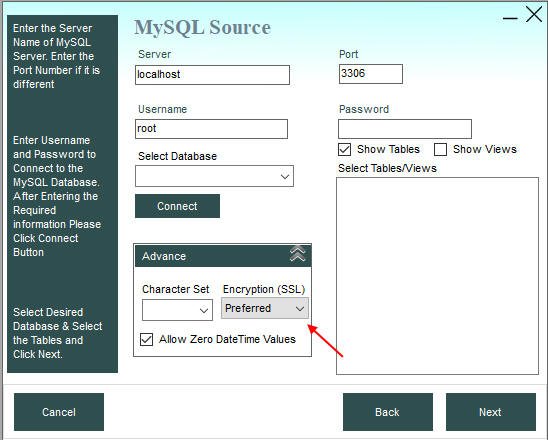
This setting will use encryption if the MySQL server supports it, or will not use encryption if the server doesn't support it — the connection will get established either way.
If you want your connection to MySQL to be mandatorily encrypted, you can specify the SSL - Required setting as shown below.
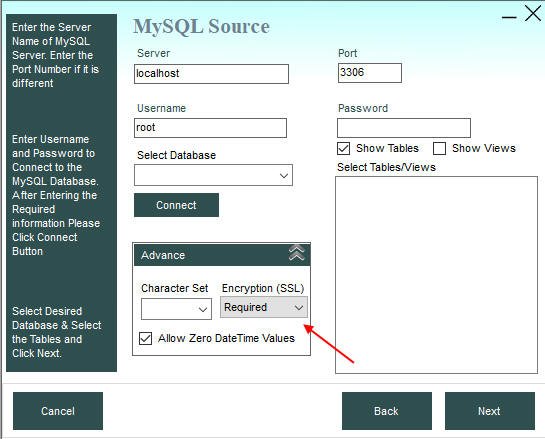
If you specify this setting, Data Loader will connect to MySQL with compulsory encryption — if the MySQL server doesn't support encryption, the connection will not be established.
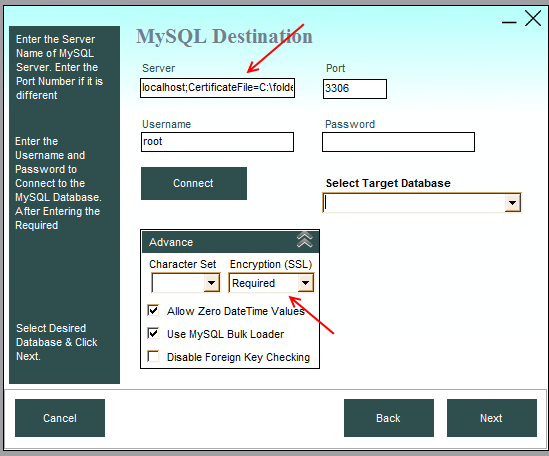
To use a file-based SSL certificate, put the path of the certificate in the Server textbox preceded by a semicolon (";") as shown below.
For example, if your SSL certificate file is C:\yourfolder\client.pfx and your server address is localhost, put the following in the Server textbox in Data Loader:
localhost;CertificateFile=C:\yourfolder\client.pfx;CertificatePassword=pass;