Convert MSSQL to MySQL easily with expert-recommended methods and tools. Learn about best practices, challenges, and the best MS SQL to MySQL migration tool.

Microsoft SQL Server is a powerful relational database management system (RDBMS) designed for enterprise applications. It supports complex queries, stored procedures, and advanced data security features.

MySQL is an open-source RDBMS widely used for web applications, offering high performance, ease of use, and strong community support. It is especially popular in LAMP (Linux, Apache, MySQL, PHP) environments.
| Feature | MS SQL | MySQL |
|---|---|---|
| Licensing | Proprietary | Open Source |
| Supported Platforms | Windows | Windows, Linux, macOS |
| Stored Procedures | Advanced support | Basic support |
| Cost | Paid (enterprise edition) | Free & Paid (Enterprise) |
The straightforward method is to dump the table data as a CSV file, create the table structure manually in MySQL by adjusting the datatypes, then import the data from the CSV file. This method — although it looks simple — isn't suitable if you have to transfer multiple tables.
There are several tools, both free and paid, available which will do the migration automatically without you writing any code. In fact, some tools do the job in just three clicks. Here is the list of tools:
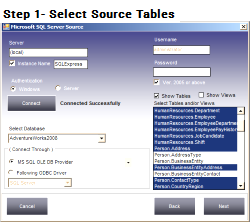
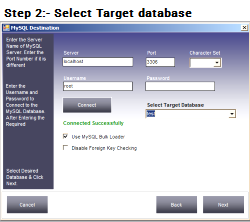
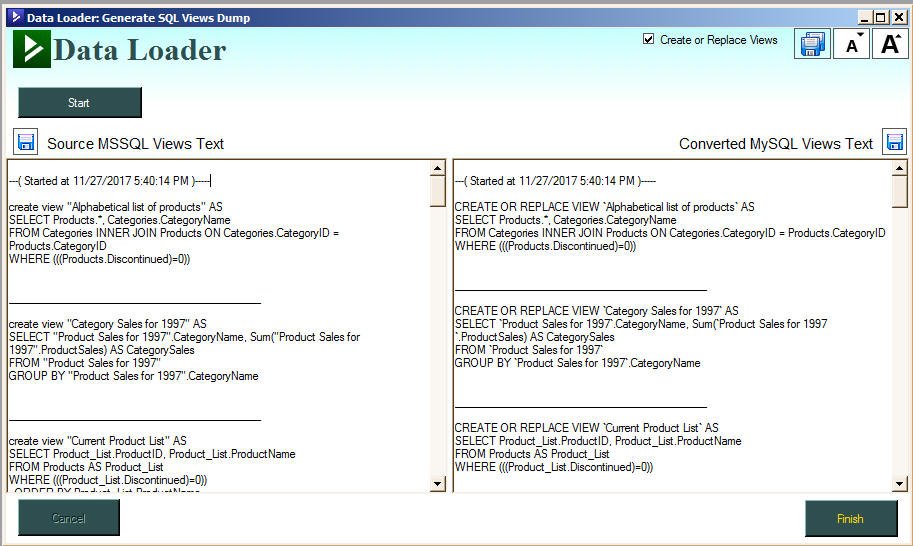
Data Loader is a powerful tool to convert and migrate data from MSSQL to MySQL or from MySQL to MS SQL Server databases. It can convert hundreds or thousands of tables in one go. While converting, you can map source table columns to matching destination table columns, and filter rows by specifying WHERE conditions. Besides tables, it can also convert Views.
Apart from conversion, it can also synchronize data between MS SQL and MySQL using its own scheduler. It can update, insert, or delete rows from target tables to match the source tables.


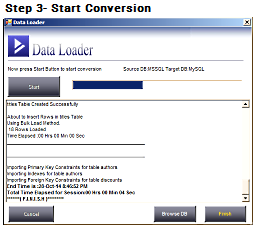
It converts schemas, data, constraints, indexes, auto increment and default values in just three steps without writing a single line of code. It automatically chooses the most appropriate datatypes and widths, and also lets users choose their own types.
Supports UPSERT loading — synchronize data from source to target by updating a matching row or inserting it if it doesn't exist. Supports INSERT loading — only inserts rows that don't already exist in the target table.
Comes with a built-in scheduler so you can run conversion jobs at specified intervals: create a session, define the schedule date and time, and Data Loader automatically executes it in the background and records the actions in a log file.
It also provides a command line interface to run migration jobs manually, so it can be easily integrated with your own application. All sessions are stored in a repository, with a user friendly interface to back up, restore, or create a new blank repository.
Besides the conventional loading method, it also supports BULK LOAD, which greatly improves performance and lets you load millions of rows in very little time.
Download Data Loader Buy Data LoaderLoad data into any existing target table with full column mapping.
Synchronize source and target tables. More
Creates SQL dump files or CSV files from any source database.
Execute sessions from the command line or other applications.
Easily manage all saved sessions.
Use Data Loader's own scheduler or Windows Task Scheduler for repeated migration jobs.
Load millions of rows at blazing speed.
Using Data Loader you can perform: MSSQL ↔ MySQL Database, MSSQL → MySQL SQL Dump file, MySQL → MS SQL Server SQL Dump file, MSSQL ↔ MSSQL Database/Dump file, and MySQL ↔ MySQL Database/Dump file.
Examples:
CREATE VIEW "Alphabetical list of products" AS
SELECT Products.*, Categories.CategoryName
FROM Categories INNER JOIN Products ON Categories.CategoryID = Products.CategoryID
WHERE (((Products.Discontinued)=0))
CREATE OR REPLACE VIEW `Alphabetical list of products` AS
SELECT Products.*, Categories.CategoryName
FROM Categories INNER JOIN Products ON Categories.CategoryID = Products.CategoryID
WHERE (((Products.Discontinued)=0))
CREATE VIEW Invoices AS
SELECT Orders.ShipName, Orders.ShipAddress, Orders.ShipCity, Orders.ShipRegion, Orders.ShipPostalCode,
Orders.ShipCountry, Orders.CustomerID, Customers.CompanyName AS CustomerName, Customers.Address, Customers.City,
Customers.Region, Customers.PostalCode, Customers.Country,
(FirstName + ' ' + LastName) AS Salesperson,
Orders.OrderID, Orders.OrderDate, Orders.RequiredDate, Orders.ShippedDate, Shippers.CompanyName As ShipperName,
"Order Details".ProductID, Products.ProductName, "Order Details".UnitPrice, "Order Details".Quantity,
"Order Details".Discount,
(CONVERT(money,("Order Details".UnitPrice*Quantity*(1-Discount)/100))*100) AS ExtendedPrice, Orders.Freight
FROM Shippers INNER JOIN
(Products INNER JOIN
(
(Employees INNER JOIN
(Customers INNER JOIN Orders ON Customers.CustomerID = Orders.CustomerID)
ON Employees.EmployeeID = Orders.EmployeeID)
INNER JOIN "Order Details" ON Orders.OrderID = "Order Details".OrderID)
ON Products.ProductID = "Order Details".ProductID)
ON Shippers.ShipperID = Orders.ShipVia
CREATE OR REPLACE VIEW Invoices AS
SELECT Orders.ShipName, Orders.ShipAddress, Orders.ShipCity, Orders.ShipRegion, Orders.ShipPostalCode,
Orders.ShipCountry, Orders.CustomerID, Customers.CompanyName AS CustomerName, Customers.Address, Customers.City,
Customers.Region, Customers.PostalCode, Customers.Country,
CONCAT(FirstName , ' ' , LastName) AS Salesperson,
Orders.OrderID, Orders.OrderDate, Orders.RequiredDate, Orders.ShippedDate, Shippers.CompanyName As ShipperName,
`Order Details`.ProductID, Products.ProductName, `Order Details`.UnitPrice, `Order Details`.Quantity,
`Order Details`.Discount,
(CAST((`Order Details`.UnitPrice*Quantity*(1-Discount)/100) AS Decimal)*100) AS ExtendedPrice, Orders.Freight
FROM Shippers INNER JOIN
(Products INNER JOIN
(
(Employees INNER JOIN
(Customers INNER JOIN Orders ON Customers.CustomerID = Orders.CustomerID)
ON Employees.EmployeeID = Orders.EmployeeID)
INNER JOIN `Order Details` ON Orders.OrderID = `Order Details`.OrderID)
ON Products.ProductID = `Order Details`.ProductID)
ON Shippers.ShipperID = Orders.ShipVia

Economical cost of just $99 for the Standard Version. A fully functional trial version with a 50-rows limit is available for testing.
For seamless, fast, and reliable data migration.